
Referencing AI Tools

| AI chat | AI summary | AI-generated image |
| AI tool | Listing prompts in the text | Exemptions from citing |
General Guidelines
If you use any type of content, such as text or image, generated by AI tools, you must provide an in-text citation and a reference list entry. Please note that the text-matching software, Turnitin, shows a percentage of AI-generated content separately in its similarity report. The use of AI tools should evidently be approved in the assessment guidelines.
As per the American Psychological Association’s new guideline, you can reference AI tools in two ways.
(1) AI chats (2) AI tools.
In most cases, you can use the AI chat option. Use the AI tool option only when stable links to specific chats or conversations are unavailable in the AI tool.
As it is now possible to retrieve and share specific chats, you can create an APA reference entry for a specific chat. The conventional author-date-title-source APA format is applicable to AI chat as well. Usually the 'share' option at the end of each chat provides the stable URL for the chat. For some AI tools, the share option appears at the top right-hand side of the window.
The reference template for the AI chat is the following.
AI Company Name. (year, month day). Title of chat in italics [Description, such as Generative AI chat]. Tool Name/Model. URL of the chat
The current APA guidance on recoverable AI chats shifts the focus to citing the specific, retrievable chat rather than documenting every prompt separately in the text or appendix. Because the shared chat link already preserves the interaction context, it is generally unnecessary to repeat all prompts in the narrative or include a separate appendix of prompts, as earlier guidance recommended for non-recoverable AI interactions.
That said, authors should still provide sufficient context in the text so readers can understand which aspect of the AI interaction is being discussed, especially when quoting or paraphrasing generated content. Including a brief description of the relevant prompt in the sentence itself may still help with clarity, but it is no longer essential.
When stable chat links are unavailable for an AI chat, we need to reference the AI tool. In those cases, you must provide prompts in the text and longer responses in the appendix section. If including prompts like the following provides greater contextual clarity and improves reader understanding, you can include them in the text.
“When prompted with ‘Is the left-brain/right-brain divide real or a metaphor?’ ChatGPT indicated that…”
Although the current guideline does not require prompts to be included in the text, examples are provided in the Listing prompts section below. These examples are relevant when AI is referenced as a tool and not as an AI chat with stable links.
According to current APA guidelines, an "AI use statement" is not required in the methods or introduction sections simply because AI-generated content was consulted. However, whether the use of AI should be disclosed narratively largely depends on how it was used.
For example:
- If AI was used substantively to generate text, summarise ideas, assist with coding/analysis, develop arguments, or otherwise contribute meaningfully to the work, transparency about that use in the methods or introduction section should be included.
- If AI was used more incidentally (similar to a search engine, brainstorming aid, spelling/grammar support tool, or retrieval mechanism), then a formal methods disclosure may not be necessary, especially when the recoverable AI chats themselves are already cited in the reference list. (See the section 'Exemptions From Citing AI Tools' for more details.) Please note that the text generated by many grammar-checking tools gets flagged as AI by Turnitin. Most versions of Grammarly (aside from Academic versions provided by NMIT) produce AI-generated text by default, unless generative AI has been deactivated(external link).
With the introduction of a new template for referencing AI chats, APA treats properly quoted and cited AI-generated text as it would any other directly quoted source. In other words, if one uses (1) quotation marks, (2) provides an appropriate in-text citation, and (3) includes a corresponding reference entry, then the quoted material is functioning as a properly attributed quotation rather than undisclosed AI-generated writing.
If the AI chat includes visible paragraph numbers, section labels, headings, or otherwise organized segments, those locators may be used in citations similarly to other unpaginated sources.
For example:
(OpenAI, 2026, “Brain Hemisphere Discussion” section, para. 3) or (OpenAI, 2026, para. 3) if paragraph numbering is reasonably identifiable.
If the chat interface does not provide stable paragraphing or sections, APA does not require authors to create artificial paragraph numbers.
AI chat
Template-Reference list entry
AI Company Name. (year, month day). Title of chat in italics [Description, such as Generative AI chat]. Tool Name/Model. URL of the chat
In-text citation
- Parenthetical citation: (AI Company Name, year)
- Narrative citation: AI Company Name (year)
Reference list entry examples
To create reference examples for this post, we asked two AI tools for a list of grammar concepts that students should know by the end of high school. Our prompt was “I’d like a list of grammar topics that a student should understand by the time they graduate from high school.” In this scenario, we want to include those chats as references in a paper.
Anthropic. (2025, May 20). Essential grammar topics for high school graduates [Generative AI chat]. Claude Sonnet 4. https://claude.ai/share/329173b2-ec93-4663-ac68-4f65ea4f166dopens in new window(external link)
Google. (2025, May 22). High school grammar concepts overview [Generative AI chat]. Gemini 2.5 Flash. https://g.co/gemini/share/a1306ce12929(external link)
- Author: The author is the company responsible for developing the AI tool. For example, OpenAI is the author of ChatGPT, Google created Gemini, Anthropic is the company responsible for Claude, and Perplexity AI is the author of Perplexity.
- Date: The date in an AI chat reference is the specific year, month, and day on which a chat occurred or concluded.
- Title: The title is the title of the chat (in italic sentence case) followed by a bracketed description to clarify for readers the nature of the source; for example, “[Generative AI chat].” Adapt the wording within square brackets as needed.
For AI summaries from search engines like Google, the title may not be available, unlike with AI tools like Gemini. In those cases, you can use the AI summary description in brackets as the heading. Please note that the heading within the square bracket is not italicised. See the AI summary example below. - Source: The source begins with the name of the AI tool, which can be general (e.g., ChatGPT or Gemini) or the name of the model (e.g., ChatGPT-5 or Gemini 2.5 Flash). The final component of the source element is the chat URL. Now, APA does not require the version number of the AI tool used. If the version number is unavailable, you just need to use the tool's generic name, such as Gemini or Claude. Usually, the share option at the end of each chat provides you with a stable URL.
For AI summaries available in search engines, the name of the AI tool that works behind the search engines may not be evident. For example, Gemini is the AI tool that powers the AI summaries in Google Search. In those cases, you can omit the AI tool’s name (see the AI Summary example below). But if someone put Google AI or Gemini in the source element, it is also correct.
In-text reference
Parenthetical citation
_______ (Anthropic, 2025)
Narrative citation
According to Anthropic (2025) ______
According to Google (2025) ______
AI summary example
An AI summary (also known as an AI Overview) in a search engine is an AI-generated answer placed at the top of search results.
Google. (2026, May 15). High school grammar concepts overview [AI summary]. https://share.google/aimode/wHksbn9uuGrI2XteG(external link)
If the title is not evident, you can also use the following option.You can use the AI summary description in brackets as the heading. Please note that the heading within the square bracket is not italicised.
Google. (2026, May 7). [Answer to a query about Māori health inequality in recent years] [AI summary]. https://share.google/aimode/gUGl9OrgUBD5jrI2d(external link)
AI-generated Images example
To create references for images, videos, and other multimedia resources, you can also use the AI chat template. See the example below.
Referencing an image generated by Leonardo AI, an image generator tool owned by Canva.
Figure 1
Image of a Tree
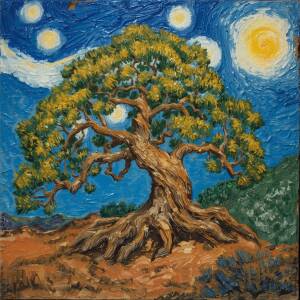
(Canva, 2026)
NMIT does not require using the full note in the APA style below an image. If the full note is required, it should be formatted as follows. Unlike other image notes, here the image is considered to be generated by the author using an AI tool.
Note. Image generated by the author using Leonardo AI by Canva from the prompt “A Vincent van Gogh-style image of a tree,” May 7, 2026 (https://app.leonardo.ai/generation/image/create-vibrant-expressive-vincent-van-gogh-style-7df689c8-57e6-4024-a1e0-8fdb287eb9da?utm_source=share_asset&utm_medium=copylink&utm_content=image(external link)). Copyright 2026 by Canva.
According to current APA guidance, AI-generated images are considered author-generated and not subject to copyright. As copyright attribution is a contentious area, it is good practice to include it when full notes are given below the image.
Reference list entry
Canva. (2026, May 11). [A Vincent van Gogh-style image of a tree] [AI-generated image]. Leonardo. https://app.leonardo.ai/generation/image/create-vibrant-expressive-vincent-van-gogh-style-7df689c8-57e6-4024-a1e0-8fdb287eb9da?utm_source=share_asset&utm_medium=copylink&utm_content=image(external link)
- As Leonardo AI is owned by Canva, it is listed as the author.
- As a specific title is not available for the image, a descriptive title is given in the square brackets. Titles within Square brackets are not rendered in italics.
- After the title, a description of what was produced is given in square brackets [AI-generated image]
- A direct link to the image is provided. In most tools, the image's share option provides a stable URL.Being the AI tool, Leonardo is given as the source.
AI Tools
The AI tool option is used only when stable links to specific chats or conversations are unavailable. Prefer the AI chat template in all other instances.
Template
Author of the AI model used. (Year of AI model version). Name of AI model used (version of AI model used) [Type or description of AI model used]. Web address of AI model used
The following is an example of content generated by ChatGPT
Reference list entry
OpenAI. (2025). ChatGPT [Large language model]. https://chatgpt.com(external link)
- The author is the organisation or the person who developed this tool.
- The date is the year in which the AI tool was most recently updated. If you are unsure of the date, ask the AI. If the tool does not indicate the date of the last update, use the copyright date provided on the website or in the app.
- The title is the name of the AI tool, which can be general (e.g., ChatGPT or Gemini) or the name of the model (e.g., ChatGPT-5 or Gemini 3 Flash)
- After the title information, give a description of the AI tool in square brackets. As the OpenAI describes their AI tools as large language models, provide that information in square brackets after the version info, which is given in parentheses. For other AI models, use the respective companies' descriptions.
- The source element is only the URL of the AI tool because the author and publisher of the AI are the same. As in all APA Style references in which the author is the same as the publisher, that name is included only once in the reference (in the author element)
In text reference
Parenthetical citation
_______ (OpenAI, 2025)
Narrative citation
According to OpenAI (2025) ______
An example of a reference list entry for another AI tool, Gemini, is given below.
Reference list entry
Google. (2025). Gemini 3 Flash [Large language model]. https://gemini.google.com(external link)
In-text reference
________ (Google, 2025).
Narrative citation
According to Google (2025) ________
Listing Prompts in the Text
When the AI tool does not provide stable URLs for specific AI chats, you need to reference AI tools. When you reference AI tools, you must provide the prompt that you have given to the tool to generate responses.
You can provide long responses from AI tools in your appendix section. If you are revising your query on a particular topic using more than two prompts, you can give them in the appendix.
You can include AI-generated text in the following way in your assignment.
Example sentence 1
When prompted with “explain cultural relativism in simple terms,” the text generated by ChatGPT noted that cultural relativism stands for evaluating a culture in its own context (OpenAI, 2023).
Example sentence 2 (Direct quote)
When questioned with the prompt “health inequality experienced by Māori” ChatGPT-generated text indicated that “the health inequality experienced by Māori has wider social and economic consequences. Poor health outcomes among Māori result in decreased workforce participation, which affects the productivity of the wider economy. Additionally, Māori communities experience increased poverty, which perpetuates the cycle of health inequality” (OpenAI, 2023).
So, the in-text reference format would be the software company and the date. In this example, ChatGPT was developed by OpenAI. Thus, the in-text reference is
(OpenAI, 2023)
As explained in the referencing templates section, the entry in the reference list should be in the following format.
OpenAI. (2023). ChatGPT [Large language model]. https://chat.openai.com/chat(external link)
Exemptions From Citing AI Tools
AI as a search engine
If you used AI as a search engine or intermediary to find information, similar to using Google search or a database search, it is, in most cases, not necessary to cite AI at all. It is the same as if you used Google search to find a source: After reading those sources, if you quote or paraphrase from them, cite those individual sources, not the search results or summary from the AI tools. But if you use an AI tool as a search engine extensively in literature reviews or meta-analyses, it is good practice to mention this in the methods section, which describes your search strategy.
If you use an AI tool to conduct searches, ensure it cites sources. Additionally, read those sources yourself to verify their authenticity, relevance, and trustworthiness to avoid any potential inaccuracies.
AI integrated into common software
You also do not need references or citations when using common AI-enabled software. For example, some versions of Microsoft Word use Copilot to help refine your writing. Using built-in word-processing features like this, which may in turn use AI, is similar to using the spell-check, grammar-check, and other helpful tools within a word processor. You wouldn’t cite spell-check, so you don’t need to cite Copilot within Microsoft Word. It should be noted that all advanced features of Copilot need citations, with the exception of its use as a built-in AI module in MS Word for spelling and grammar checks.
Even though APA's current guidelines do not require citations for images generated by common software like Canva, NMIT advises you to reference AI-generated images using the template given above to avoid confusion between images created by human creators and those generated by AI and to address copyright issues.
See Also
For more examples of AI chats and tools, see this APA-style blog article.(external link)
For detailed guidelines, see this article(external link) from the APA Style blog.
NMIT’s generative AI guidelines for ākonga [PDF 337 KB] and Kaimahi [PDF 232 KB]